Aesthetics
Agriculture
Ambedkar Studies
Ancient History & Archaeology
Anthropology
Art & Architecture
Astrology & Astronomy
Aviation
Ayurveda
Biography
Biology
Biotechnology
Botany
Buddhism & Tibetan Studies
Chemistry
Children Books
Children Studies
Christianity
Commerce & Management
Computer Science
Cookery
Crime & Police
Dairy & Veterinary
Dalit Studies
Defence & Military Studies
Disaster Management
Economics
Education
Engg: Architecture
Engineering
English Literature
Environmental Studies
Fashion & Textile
Fiction
Food Science
Forensic Science
Forestry
Gandhian Studies
Gender Studies
Geography
Geology
Health Care
Himalayan Studies
Hindi Literature
Hinduism
History & Culture
History: Medieval
History: Modern
Home Science
Hotel Management
Human Rights
Islamic Studies
Journalism & Mass Media
Language / Linguistic / Literature
Law
Library Science
Manuscriptology
Maritime Studies
Mathematics & Statistics
Medical
Migration/Refugees
Mind, Body & Spirit
Mines & Minerals
Museums & Science Centres
Music & Dance
Nanotechnology
Natural History
Numismatics & Epigraphy
Paintings
Performing Arts
Personality Development
Philosophy
Physics
Political Science
Poultry Science
Princely States
Psychology
Public Administration
Religion
Religion: Jainism
Religion: Sikhism
Research Methodology
Rural Development
Sanskrit
Science & Technology
Social Work
Sociology
Sustainable Development
Tantra & Occult Science
Terrorism & Militancy
Tourism
Travels & Travelogue
Tribal Studies
Urban Development
Vedas / Puranas / Upanishads
Wild Life
Women Studies
Yoga & Meditation
Zoology

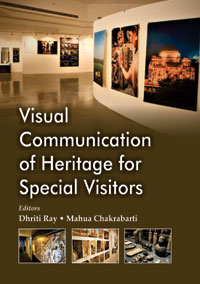
Visual Communication of Heritage for Special Visitors
Author Dhriti Ray & Mahua Chakrabarti (eds)
Year 2025
Binding Hardback
Pages xx+331p, 26 cm.
ISBN10, ISBN13 9386463644, 9789386463647
Short Description
Museums are custodians of our collective heritage, preserving stories of the past through artifacts, paintings, and exhibits. As societies grow more diverse, museums face challenges in making these experiences accessible and engaging for all visitors. Effective visual communication is crucial in making history relatable and understandable, bridging cultural, linguistic, and educational gaps.
This anthology discusses how museums embrace inclusive design, ensuring that exhibits cater to people with various abilities, backgrounds, and needs. By integrating technology, multilingual displays, and culturally relevant narratives, museums can create dynamic, immersive experiences that resonate with a wide audience, fostering deeper understanding and connection to heritage.
List Price: US $62.95
Your PriceUS $47.21
You Save25.00%